Table of Contents
Grand Duchy of Dael Riata
Dael Riata is a poor land sandwiched between mountains to its North and East, and the Sea on the West. To the south sits the related but way more prosperous Kingdom of Bernicia. Riven by centuries of internecine warfare between tribes with a culture of raiding and blood feuds the Daels are impoverished. Many of their towns (all of the successful ones) are fortified, and fortlets and castles abound between the hills and lakes. The capital is Dalreoch.
A seafaring people loosely linked to the Skyssians based on a collection of Islands and the nearby coastal lands to the East of Skyss. Unlike Skyss they're riven by factions and internecine warfare, which is why they haven't banded together to be a greater power in the world. Many Daels leave the area and seek their fortune elsewhere, and it is common to find little groups of Daels onboard a Skyssian ship, or in an enclave somewhere in a civilised town in another country. One thing that helps Daelians stand out is their culture of education which means thay are way more literate than most other peoples.
Geography
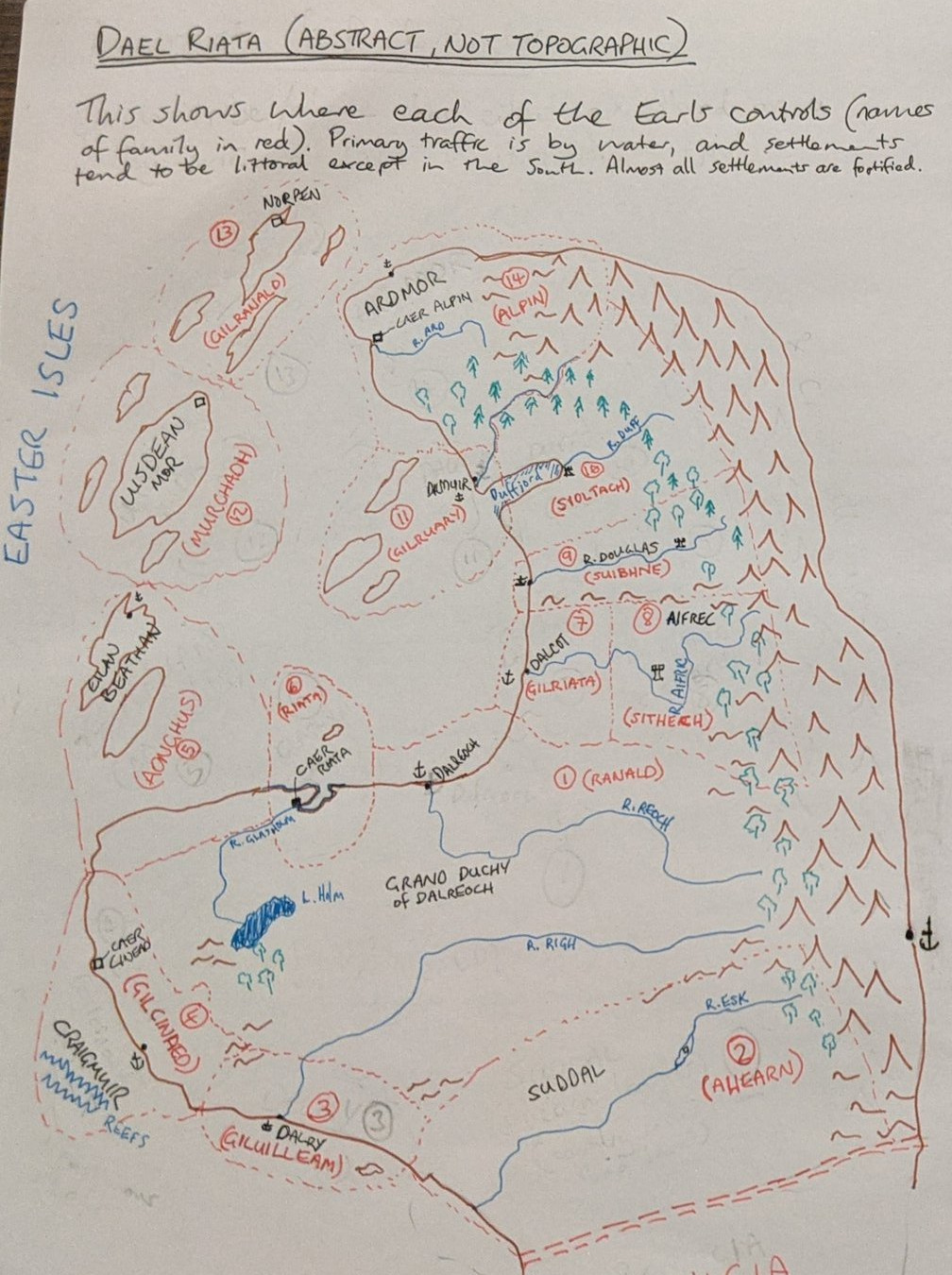
The primary industries of Dael Riata are inshore fisheries, there are substantial islands off the west coast, paradoxically called the Easter Isles. This name harks back to the days when there was no difference between the Daels and the Skyss, and both nations sailed where they pleased. Skyss and it's isles are the Western Isles. As well as fisheries lots of oats and barley are grown, along with sheep and shaggy brown cattle with wide horns.
As well as exporting people as skilled sailors and mercenaries there is a small shipbuilding industry from the two major ports Dalreoch and dalmuir on the west coast. Large forests dominate the hills and mountains, and they provide good quality timber for ship-building. The Daels are reknowned ship-builders, possibly more accomplished than the Skyssians. Dael ships are fast, sleek, and have strong hulls able to withstand the ice often found in the waters off their Northern Cape.
People
Dael Riata is ruled by a hereditary monarch, which has been in the hands of the Ranald family for almost three hundred years, before that there was a two decade inter-regnum filled by a very bloody civil war and an intervention by the King of Bernicia which united the Dael Riatan's against the Bernicians. Originally the Riata dynasty founded the Kingdom, but the crown passed out of their hands to the Ruary dynasty, which died out (although one of their cadet branches, the Gilruary, still exist).
The current monarch is Alasdair V, Grand Duke of Reoch. He succeeded to the throne as a baby when his mother, Queen Caoimhe, was forced to abdicate by a coalition of nobles. The main nobles of Dael Riata are:
- The Ranald, Grand Dukes of Reoch & Kings of Dael Riata
- The Ahearn, Earls of Suddal, known colloquially as the Horse Lords.
- The Giluilleam, Earls of Dalry, and relative newcomers to Dal Riata.
- The Gilcinead, Earls of Craigmuir
- The Aonghus, Earls of Beatham.
- The Riata, Dukes of Glasholm, the founders of the Kingdom of Dael Riata.
- The Gilriata, Earls of Dalcot, a cadet branch of Riata that now surpasses them.
- The Sithech, Earls of Aifric, the Old Wolves.
- The Suibhne, Earls of Douglas, famed for their hospitality and generosity.
- The Sioltach, Earls of Duff, host to the Unicorn Troop.
- The Gilruary, Earls of Dalmuir, the second port of Dael Riata.
- The Murchadh, Earls of Uisdean, notorious raiders and self-proclaimed Sea Kings.
- The Gilranald, Earls of Norpen. A cadet branch of Ranald installed on the Northern most islands as a foil to the Muchardhs.
- The Alpins, Earls of Ardmor. Guardians of the great forest in the North.
History of the Grand Duchy of Dael Riata
The history of the Grand Duchy of Dael Riata is a chronicle of a seafaring people defined by centuries of internecine warfare, tribal raiding, and blood feuds. Sandwiched between the eastern mountains and the western sea, the nation's past is marked by the struggle to maintain independence from the prosperous southern Kingdom of Bernicia and the internal rivalry of its noble houses.
Founding and Early Dynasties
The Kingdom was originally established by the Riata dynasty. Following the decline of the founders, the crown passed to the Ruary dynasty. However, this lineage eventually died out, leading to a bloody two-decade inter-regnum characterized by civil war. This period of instability invited intervention from the King of Bernicia, a move that paradoxically united the disparate Dael tribes against a common southern foe.
The Rise of House Ranald
The current ruling Ranald family has held the throne for nearly three hundred years. Their dominance began in earnest following the death of King Ruaraidh X (reigned 434–528).
Wars of Independence (529–544): Following Ruaraidh X's death, Edmund I of Bernicia attempted to intercede in the succession. A coalition of nobles eventually chose Alasdair Ranald (the first) as King after he successfully defeated the Bernician forces in several battles. The Battle of Dalry (666): During a later invasion by Edmund II of Bernicia, the Dael forces achieved a significant victory at Dalry. Iain Murchadh, the 4th Earl of Uisdean, famously killed King Edmund II in hand-to-hand combat during the engagement.
Recent History and the Minority of Alasdair V
The 3rd century of the Ranald era has been particularly tumultuous:
- Alasdair IV and the Ambush (739): King Alasdair IV attempted to claim the Bernician throne through his brother-in-law, Harold VIII. His army was ambushed by Bernician nobles, resulting in the King's death and heavy losses among the Dael nobility.
- The Abdication of Queen Caoimhe: Queen Caoimhe succeeded her father as a child, governed by a regency council that included Sean Alpin. Later, her attempt to marry a Skyssian merchant and re-introduce Skyssian gods led to a noble coalition forcing her abdication after The Queen's War (754–755) in 756.
- The Minority of Alasdair V: Succeeding to the throne as an infant, the young King was raised through a series of four regents, most notably his cousin Bhaltair Gilranald, the Earl of Norpen. At age 15, Alasdair V asserted his adulthood and began a campaign to centralise control.
The Massacre at Caer Suibhne (774)
A defining moment of recent stability—or tyranny, depending on the perspective—occurred at Caer Suibhne. Seeking to resolve the long-standing defiance of the Murchadh family, the King invited Domnhall Murchadh (5th Earl of Uisdean) and his brother Fearchar to a private negotiation. Despite the laws of hospitality, both brothers were killed by the King's Steward, Iain Alpin. While the King officially claimed they attempted to assassinate him, many believe it was a calculated move to break the power of the “Sea Kings” of Uisdean. This event led to the current Earl, Diarmad Murchadh, swearing allegiance under threat of total extirpation.