Table of Contents
Welcome to James Kemp's Wiki
This is a collaborative web platform that allows people to edit1) the web pages to provide additional content for some of the stories I have written and the roleplaying games that I am involved in, whether as a player or GM.
There are several namespaces operating slightly different wiki subjects. These are, in no particular order:
- Skyss - Story Background - a fantasy novel I wrote for NaNoWriMo 2016.
- Perfects - background for the near future story and some police roleplaying that I ran in that universe
- Theocracy of Daprav - A D&D campaign that I ran with Glasgow University Games Society around 2002-3.
- Jim Wallman's Universe - a roleplaying by e-mail campaign that I play in, this is an unofficial wiki and none of it is canon unless Jim says it is.
- Interstellar Freelance Unlimited - subset of the Universe pages covering the activities of a mercenary company that we are currently roleplaying every Full Moon.
- Earth Imperium pages. These cover the activities of the Government of the Solar republic (aka Earth Empire) in Jim's Humanity Will Prevail campaign, including the Earth Imperium News Items.
- Free Worlds Alliance - covering the activities of another emerging polity in the Humanity Will Prevail campaign. Mostly contributed by Eric Moroney.
- Universe Background - page collecting the various bits of background info that have come up in various e-mail discussions for the campaigns set in Jim Wallman's Universe.
- Master map of the Universe (6Mb PDF, as at 3212).
- Delta Green - some roleplaying campaigns about horror and conspiracy. The main one was set in Berlin in 1953.
- Free games rules - a collection of free rules for wargames and other sorts of face to face games that I have designed or run.
- Wargames rules - I'm not just a player of games, I also do rules for them from time to time as well as one-off games. A primary outlet for this is through Chestnut Lodge Wargames Group.
- Other free rules - at the moment just those for the 1689 (Orange or Lemon? and Bonnie Dundee, respectively about the debates in the Scots Parliament and then the military campaign of Viscount Dundee during 1689) and The Other Side of the COIN (about what makes people become insurgents). All games that I have have produced for Chestnut Lodge Wargames Group.
- Background for a near future universe where I have written some fiction and also run some roleplaying games in.
Comments and complaints to me at webmaster@full-moon.info please.
James Kemp
Tag Cloud
Recent Additions
Caer Suibhne
Caer Suibhne is the ancestral seat of the Suibhne family, the Earls of Douglas. Situated within the mainland of Dael Riata, it is historically regarded as neutral ground suitable for high-level noble negotiations.
Stories
Caer Suibhne is in the story “The King's Peace”
- First appears - “The King's Peace,” a standalone short story detailing Dael Riatan politics
- Function: The castle serves as the primary setting for the climax of the story, where a diplomatic dinner intended to secure the “King's Peace” turns into the infamous massacre of the Murchadh leadership.
Description
Caer Suibhne rises from a rocky island in the middle of a fast flowing section of the River Douglas. The main keep is built directly out of the rock, surrounded on all sides by fast flowing water. Over generations the rocks in the river have been artfully placed to make any attempt to cross in boats very dangerous. There’s a wider curtain wall around Caer Suibhne, enclosing a small township of those that support the keep. It sits mostly on the Northeastern bank of the river, and is joined to the keep by a wooden bridge, which raises overnight. There is no safe access to Caer Suibhne other than through the bridge. Either side of the castle the hills are steep, and the ground uneven on them. The only way to progress further up river is to pass by the castle itself, or under the fall of shot from the catapults on the battlements, or the archers stationed beside them. A small battery on the Northwestern cliff ensures that nothing could sneak by. That battery is even more impregnable than the keep of Caer Suibhne, it sits atop a 200 foot sheer rock cliff, access is via a winding path that is in full view of the defenders and the main Keep. Heavier items, including provisions, are hauled up the rock by a rope windlass operated by the catapult crew and the guards.
Caer Suibhne is a substantial stone castle featuring a Great Hall dominated by a large fireplace with wood panelling and flagstone floors. The castle is large enough to contain multiple corridors patrolled by guards and dedicated royal apartments for visiting monarchs. During the events of 774, it was the site where the rules of hospitality, traditionally sacred to the Suibhne family, were bloodily violated when Domnhall Murchadh and his brother Fearchar were killed in the Great Hall.
Relationships
People
Notable people
- Alasdair Suibhne: The 7th Earl of Douglas and the host of the fatal 774 negotiation.
- Alasdair V: The King of Dael Riata, who claimed the Murchadhs attempted to assassinate him in the castle.
- Iain Alpin: The King's Steward and Commander of the Lifeguard who executed the Murchadh brothers within the hall.
- Domnhall Murchadh: The 5th Earl of Uisdean, killed here by Alpin.
- Fearchar Murchadh: Brother to Domnhall, also killed during the negotiation.
- Mister Soutar: An official or castellan for the Earl of Douglas who manages castle retainers
Places
- Douglas: The Earldom where Caer Suibhne is located.
- Dael Riata: The Grand Duchy that encompasses the Suibhne lands.
Rules of Hospitality
The rules of hospitality are a foundational pillar of civilised behaviour within the Grand Duchy of Dael Riata. These customary laws apply across all social strata, though the burden of generosity increases significantly for the nobility and those higher in the social hierarchy.
Formalities of Hosting
The offering and receiving of hospitality are governed by strict protocols to ensure the safety and dignity of both parties:
- Authority to Offer: Only a householder or their designated steward has the formal authority to offer hospitality to a guest.
- Imposed Hosting: In certain circumstances, a local landowner may require a household to host guests. In these instances, the landowner is expected to compensate the household for any food or drink consumed and cover any damages incurred as if they were the primary host.
- Transactional Exceptions: These rules do not apply to commercial establishments like inns or guesthouses (such as the Water Gate in Dalreoch), where hospitality is considered transactional rather than a civic or moral duty.
- Short Visits: A visitor may stay in a house for business without invoking these rules, provided they refuse all food and drink. Once a guest accepts even a small morsel or a drink, the full weight of the rules of hospitality is deemed to apply.
Expectations and Obligations
While there is a general expectation that hospitality will be provided—especially since most of the country lacks formal inns—it is not an absolute requirement.
Grounds for Refusal
A host may legitimately refuse a traveller under specific conditions:
- If the host lacks sufficient food to feed the guest without skipping a meal themselves (though this rarely applies to the armed or noble classes).
- If a bloodfeud exists between the host and the prospective guest.
- If the presence of the guest creates an immediate risk of the house being raided.
- If the guest refuses to agree to abide by the formal rules.
- If there is a dedicated guesthouse for strangers nearby.
Conduct of the Guest
A guest is under a sacred obligation to “keep the peace” while under a host's roof.
- Prohibition of Violence: Guests must not bring violence to the house or engage in conflict with anyone else present, whether they were invited or not.
- Duration of Protection: The obligation to maintain the peace extends beyond the physical stay, lasting until noon on the day after the guest leaves the house.
- Etiquette: Guests must wait for the host to offer facilities, such as food or water for washing, before helping themselves. A “good host” is expected to anticipate these needs, providing sleeping quarters and a fire if the weather is cold or damp.
Fugitives and Pursuit
If a guest is a fugitive and their pursuers arrive, the host is expected to remain strictly neutral. The host should not shelter the guest from the pursuers, nor should they actively hand the guest over. The proper etiquette is for the host to insist the guest leaves immediately, though a good host will not mention the guest's presence to the pursuers. Guests should ideally leave early enough to reach another host before sunset.
Historical Breaches
The violation of these rules is considered a grave offense, often leading to deep-seated resentment and civil unrest.
- The Murchadh Precedent: The Murchadh family held these rules in such high regard that they famously hanged one of their own lieutenants for breaking hospitality.
The Water Gate Inn
The Water Gate is a bustling inn and boarding establishment located in the capital city of Dalreoch. It serves as a vital hub for visitors, traders, and noble entourages, particularly during major events like royal weddings.
Stories
They are in the story
- First appears - “Arrivals,” a narrative set five days prior to the wedding of King Alasdair V.
- Function: The establishment acts as a center for intelligence gathering and a base of operations for Aodh MacAodh, who uses his staff to collect information on city happenings and noble movements for his clients. It also provides a “safe house” for holding individuals away from the City Watch.
Description
The Water Gate is situated on the banks of the River Reoch, near the North Bridge and adjacent to the Berenician Embassy. Its most notable feature is a private jetty that sees significant action, as it allows for the transport of goods and people from upstream while bypassing the formal customs checks located in the Merchant City. The establishment is large enough to feature an Earl's suite, capable of housing a noble's entire family and household staff. It includes several distinct areas:
- The Main Inn: Known for being “mobbed” during peak times, with every bed filled and extra ones frequently knocked together to meet demand.
- Side Rooms: Used for private or clandestine business, such as holding the unconscious Iain Black.
- Side Door: Provides a discreet entrance for those wishing to avoid the main thoroughfares.
The inn operates on a transactional basis, meaning the strict Daelian rules of hospitality do not apply as they would in a private home; guests pay for their stay, and the proprietor is known to charge double the usual rate during periods of high scarcity.
Relationships
People
Notable people
- Aodh MacAodh: The shrewd proprietor who manages the inn and runs an extensive informer network.
- Fast Earsaid: A staff member and enforcer who assists Aodh with building maintenance and “security” tasks.
- Mairi and Helena: Workers at the inn who, during the royal wedding preparations, assist noble guests with dressmaking and tailoring.
- The Earl's Steward: An unnamed official who receives gathered intelligence from Aodh regarding who is in town and what they are up to.
- Iain Black: The bastard son of the King's Steward, who was held at the Water Gate after being drugged with “distilled dragonmouth”.
Places
Queen Caoimhe Ranald
Queen Caoimhe (whose name means “Beautiful, gentle, kind”) was the former reigning monarch of the Grand Duchy of Dael Riata. She was the only child of King Alasdair IV (reigned 700–739) and the mother of the current sovereign, Alasdair V.
Accession and Regency
Caoimhe came to the throne at the age of nine in 739, following the death of her father in an ambush by Bernician nobles during his ill-fated attempt to claim the southern throne. Due to her youth, she was governed by a council of regents that included Sean Alpin, the Earl of Ardmor. During this period, the Earl's wife, Ealasaid Riata, acted as the Queen's matron and oversaw her welfare.
Early in her reign, she made a significant political move to “clip the wings” of the Murchadh family by translating the father of Bhaltair Gilranald to the Earldom of Norpen, displacing the Murchadhs from those northern islands.
Scandal and Religious Tension
As she reached adulthood, Caoimhe's rule became increasingly controversial:
- The Skyssian Merchant: She became enamoured with a “suspicious Skyssian merchant” and confided in her matron that she intended to marry him and name him Prince Consort. While the merchant eventually escaped Dael Riata, he was the father of her son, Alasdair V (born 754).
- Religious Reforms: She attempted to re-introduce Skyssian gods to Dael Riata, seeking to replace the traditional Daelian deities worshipped by the small folk and the nobility.
Deposition and Abdication
The combination of her Skyssian relationship and her religious policies led to a civil war beginning in 754, during which the Queen was captured. A coalition of powerful nobles—including Domnhall Murchadh and Sean Alpin—feared she would bring Dael Riata under the control of Skyssian factions. Under immense pressure and for the “integrity of the kingdom,” Queen Caoimhe was forced to abdicate in 756/7. She was succeeded by her infant son, with the realm entering a long period of regency dominated by the very nobles who had deposed her.
Relationships
People
- Alasdair IV: Her father, whose death led to her childhood accession.
- Alasdair V: Her son and successor.
- Sean Alpin: Her former regent and advisor who eventually helped orchestrate her removal.
- Domnhall Murchadh: A leader of the coalition that forced her abdication, who held his own claim to the throne through his mother.
Places
Grand Duchy of Dael Riata
Dael Riata is a poor land sandwiched between mountains to its North and East, and the Sea on the West. To the south sits the related but way more prosperous Kingdom of Bernicia. Riven by centuries of internecine warfare between tribes with a culture of raiding and blood feuds the Daels are impoverished. Many of their towns (all of the successful ones) are fortified, and fortlets and castles abound between the hills and lakes. The capital is Dalreoch.
A seafaring people loosely linked to the Skyssians based on a collection of Islands and the nearby coastal lands to the East of Skyss. Unlike Skyss they're riven by factions and internecine warfare, which is why they haven't banded together to be a greater power in the world. Many Daels leave the area and seek their fortune elsewhere, and it is common to find little groups of Daels onboard a Skyssian ship, or in an enclave somewhere in a civilised town in another country. One thing that helps Daelians stand out is their culture of education which means thay are way more literate than most other peoples.
Geography
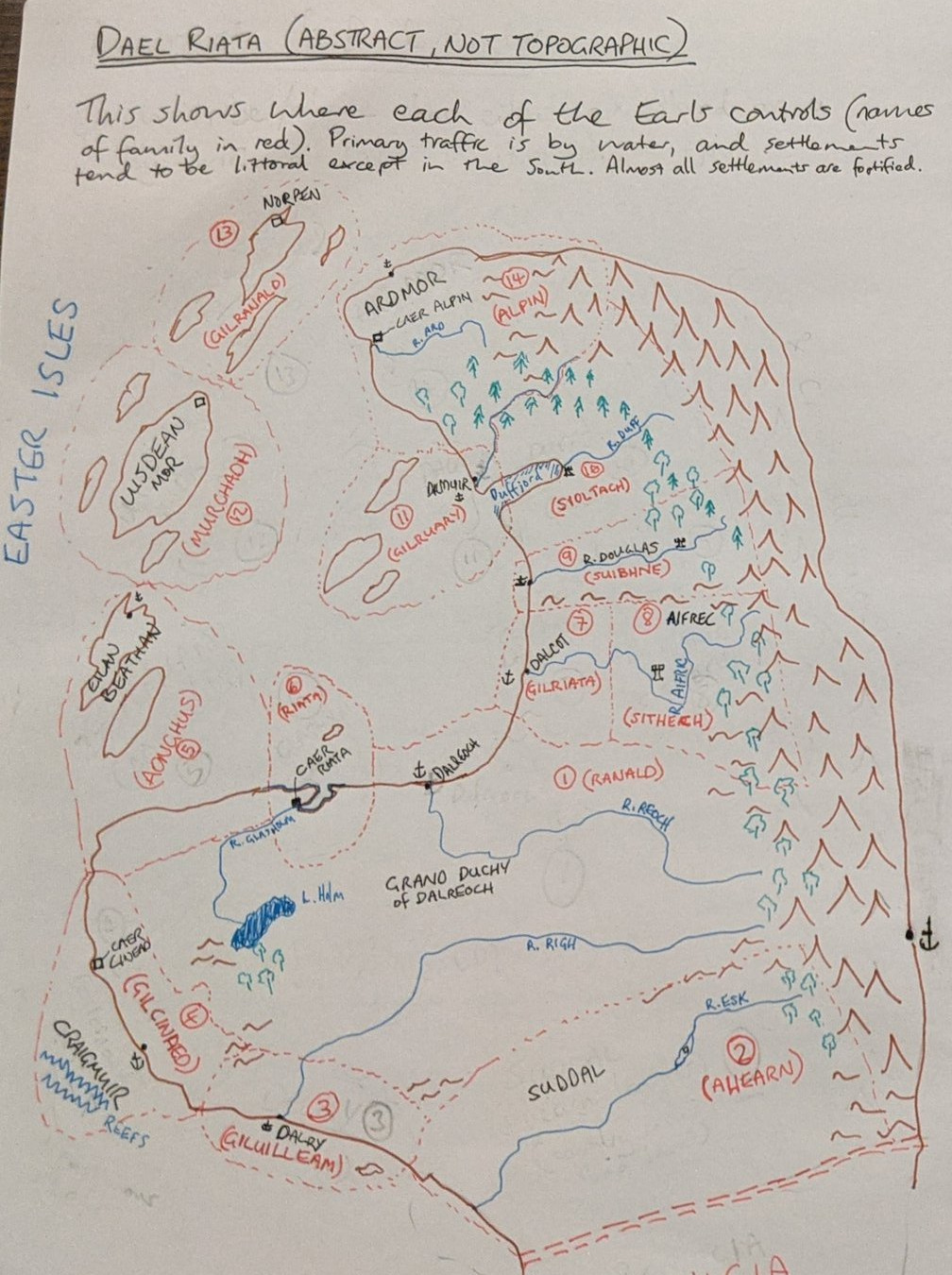
The primary industries of Dael Riata are inshore fisheries, there are substantial islands off the west coast, paradoxically called the Easter Isles. This name harks back to the days when there was no difference between the Daels and the Skyss, and both nations sailed where they pleased. Skyss and it's isles are the Western Isles. As well as fisheries lots of oats and barley are grown, along with sheep and shaggy brown cattle with wide horns.
As well as exporting people as skilled sailors and mercenaries there is a small shipbuilding industry from the two major ports Dalreoch and dalmuir on the west coast. Large forests dominate the hills and mountains, and they provide good quality timber for ship-building. The Daels are reknowned ship-builders, possibly more accomplished than the Skyssians. Dael ships are fast, sleek, and have strong hulls able to withstand the ice often found in the waters off their Northern Cape.
People
Dael Riata is ruled by a hereditary monarch, which has been in the hands of the Ranald family for almost three hundred years, before that there was a two decade inter-regnum filled by a very bloody civil war and an intervention by the King of Bernicia which united the Dael Riatan's against the Bernicians. Originally the Riata dynasty founded the Kingdom, but the crown passed out of their hands to the Ruary dynasty, which died out (although one of their cadet branches, the Gilruary, still exist).
The current monarch is Alasdair V, Grand Duke of Reoch. He succeeded to the throne as a baby when his mother, Queen Caoimhe, was forced to abdicate by a coalition of nobles. The main nobles of Dael Riata are:
- The Ranald, Grand Dukes of Reoch & Kings of Dael Riata
- The Ahearn, Earls of Suddal, known colloquially as the Horse Lords.
- The Giluilleam, Earls of Dalry, and relative newcomers to Dal Riata.
- The Gilcinead, Earls of Craigmuir
- The Aonghus, Earls of Beatham.
- The Riata, Dukes of Glasholm, the founders of the Kingdom of Dael Riata.
- The Gilriata, Earls of Dalcot, a cadet branch of Riata that now surpasses them.
- The Sithech, Earls of Aifric, the Old Wolves.
- The Suibhne, Earls of Douglas, famed for their hospitality and generosity.
- The Sioltach, Earls of Duff, host to the Unicorn Troop.
- The Gilruary, Earls of Dalmuir, the second port of Dael Riata.
- The Murchadh, Earls of Uisdean, notorious raiders and self-proclaimed Sea Kings.
- The Gilranald, Earls of Norpen. A cadet branch of Ranald installed on the Northern most islands as a foil to the Muchardhs.
- The Alpins, Earls of Ardmor. Guardians of the great forest in the North.
History of the Grand Duchy of Dael Riata
The history of the Grand Duchy of Dael Riata is a chronicle of a seafaring people defined by centuries of internecine warfare, tribal raiding, and blood feuds. Sandwiched between the eastern mountains and the western sea, the nation's past is marked by the struggle to maintain independence from the prosperous southern Kingdom of Bernicia and the internal rivalry of its noble houses.
Founding and Early Dynasties
The Kingdom was originally established by the Riata dynasty. Following the decline of the founders, the crown passed to the Ruary dynasty. However, this lineage eventually died out, leading to a bloody two-decade inter-regnum characterized by civil war. This period of instability invited intervention from the King of Bernicia, a move that paradoxically united the disparate Dael tribes against a common southern foe.
The Rise of House Ranald
The current ruling Ranald family has held the throne for nearly three hundred years. Their dominance began in earnest following the death of King Ruaraidh X (reigned 434–528).
Wars of Independence (529–544): Following Ruaraidh X's death, Edmund I of Bernicia attempted to intercede in the succession. A coalition of nobles eventually chose Alasdair Ranald (the first) as King after he successfully defeated the Bernician forces in several battles. The Battle of Dalry (666): During a later invasion by Edmund II of Bernicia, the Dael forces achieved a significant victory at Dalry. Iain Murchadh, the 4th Earl of Uisdean, famously killed King Edmund II in hand-to-hand combat during the engagement.
Recent History and the Minority of Alasdair V
The 3rd century of the Ranald era has been particularly tumultuous:
- Alasdair IV and the Ambush (739): King Alasdair IV attempted to claim the Bernician throne through his brother-in-law, Harold VIII. His army was ambushed by Bernician nobles, resulting in the King's death and heavy losses among the Dael nobility.
- The Abdication of Queen Caoimhe: Queen Caoimhe succeeded her father as a child, governed by a regency council that included Sean Alpin. Later, her attempt to marry a Skyssian merchant and re-introduce Skyssian gods led to a noble coalition forcing her abdication after The Queen's War (754–755) in 756.
- The Minority of Alasdair V: Succeeding to the throne as an infant, the young King was raised through a series of four regents, most notably his cousin Bhaltair Gilranald, the Earl of Norpen. At age 15, Alasdair V asserted his adulthood and began a campaign to centralise control.
The Massacre at Caer Suibhne (774)
A defining moment of recent stability—or tyranny, depending on the perspective—occurred at Caer Suibhne. Seeking to resolve the long-standing defiance of the Murchadh family, the King invited Domnhall Murchadh (5th Earl of Uisdean) and his brother Fearchar to a private negotiation. Despite the laws of hospitality, both brothers were killed by the King's Steward, Iain Alpin. While the King officially claimed they attempted to assassinate him, many believe it was a calculated move to break the power of the “Sea Kings” of Uisdean. This event led to the current Earl, Diarmad Murchadh, swearing allegiance under threat of total extirpation.


